

AI as First-Check at Inspection: 0% Escapes, <0.4% Overkill
Summary
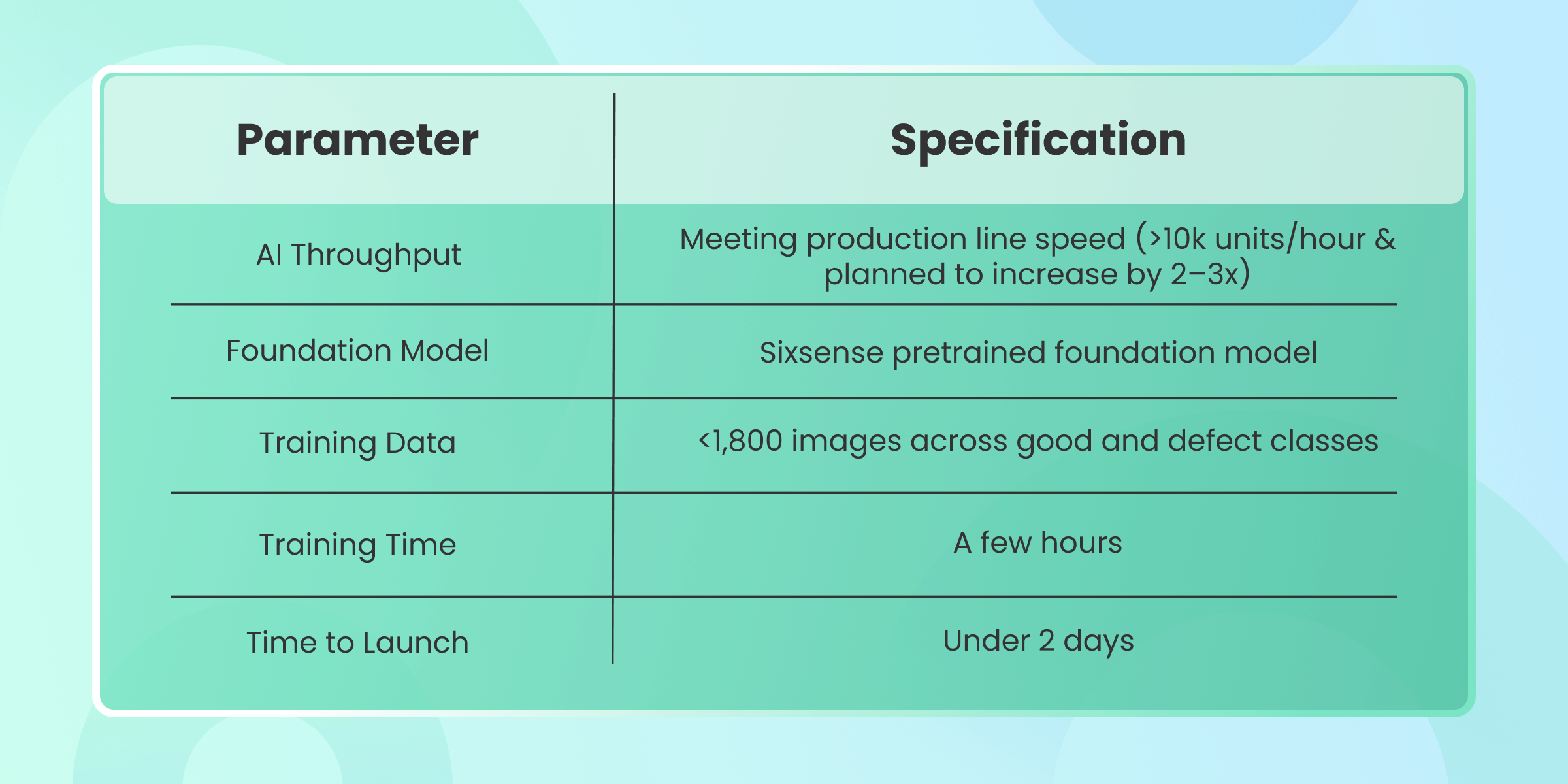
A global semiconductor manufacturer at post wire bond inspection was losing significant volumes of good units to over-rejection while still struggling to catch killer defects reliably. Sixsense deployed AI-ADC as the first check in the inspection pipeline, working with a vision OEM to analyze 100% of wire bond images in real time. Using Sixsense's pretrained foundation model, the solution achieved >99.3% accuracy, 0% under-rejections, and an over-rejection rate of just <0.4%, all while running AI at line speed. The models were launched in under two days through Sixsense's UI, with no dependency on AI specialists. The full details follow below.
Background: The Inspection Trade-Off
In semiconductor backend assembly, inspection has always involved a fundamental trade-off. Manufacturers must prevent defective units from reaching the market, but overly strict inspection criteria lead to large volumes of good units being rejected. At post wire bond inspection, this trade-off is particularly difficult to manage, as killer defects often exhibit subtle variations that rule-based systems cannot reliably detect.
The Problem: A Costly Balance Between Escapes and Over-Rejection
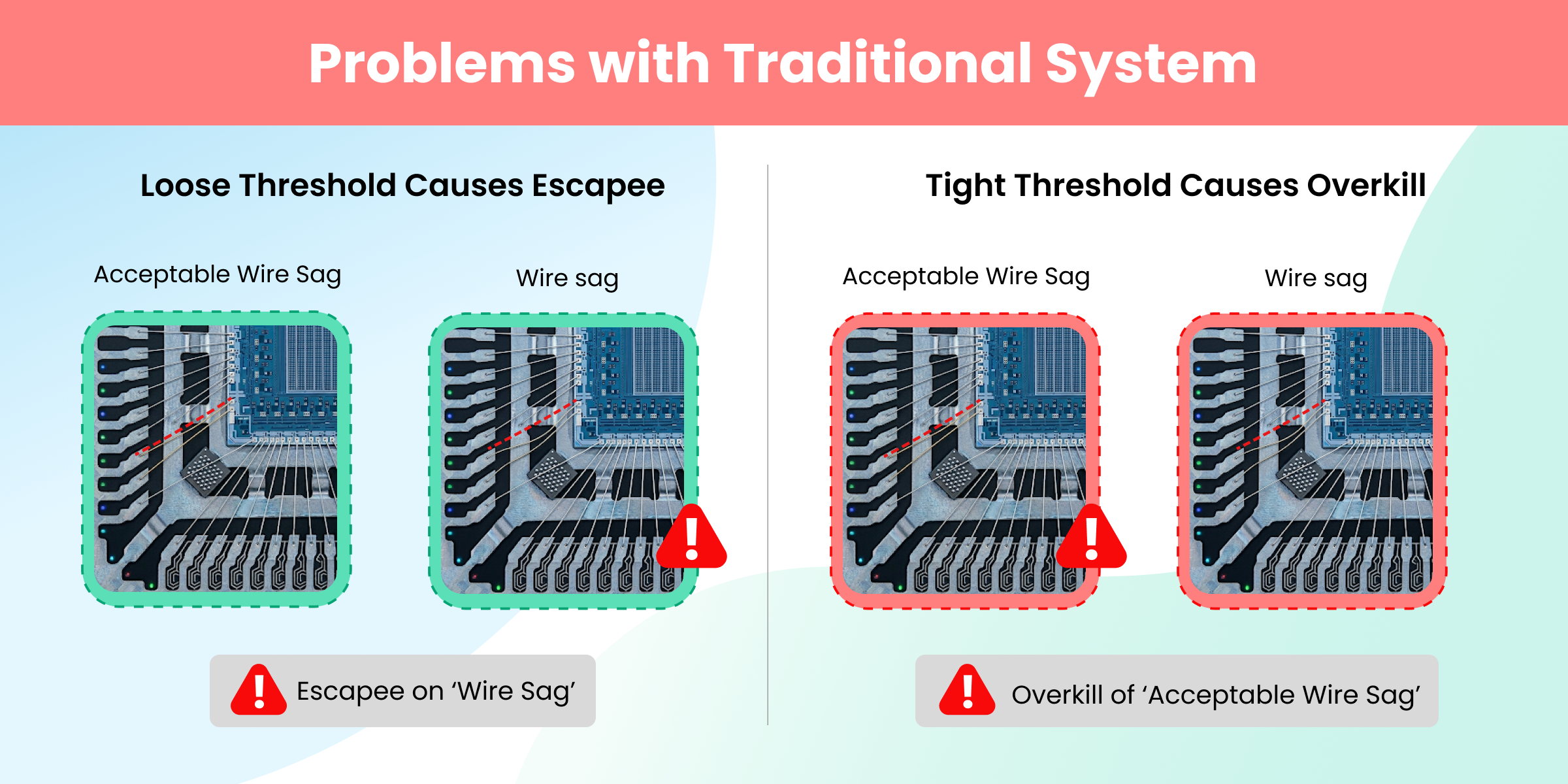
A global semiconductor manufacturer with high-volume backend assembly operations faced this exact issue. Despite having a rule-based inspection system in place at post wire bond, several killer defects continued to slip through at unacceptable rates. To reduce escapes, the team tightened inspection criteria, which introduced a new set of issues:
- A sharp increase in over-rejection of good units
- Heavy reliance on manual review to sort false rejects from true defects
- A drop in line throughput as a result of the review bottleneck
The customer had previously explored AI on their own, using general-purpose machine learning libraries to develop both supervised and unsupervised models. While the libraries offered flexibility, building and maintaining production-grade models required significant internal effort, and the resulting accuracy fell short of what was needed for live deployment. That experience left the team skeptical that any AI model could generalize well enough across their devices to be trusted as a primary inspection tool.
The Data Challenge
One of the biggest obstacles in this project was the nature of the available data. The dataset spanned <1700 images across good units and multiple defect classes, but the distribution was highly uneven. Some defect classes had fewer than 20 images, which is precisely why earlier AI efforts had struggled to reach production-grade accuracy. Defects that occur rarely in manufacturing are, by definition, hard to learn from and this is where most conventional AI approaches hit a wall.
The Sixsense Solution: AI-ADC as the First Check
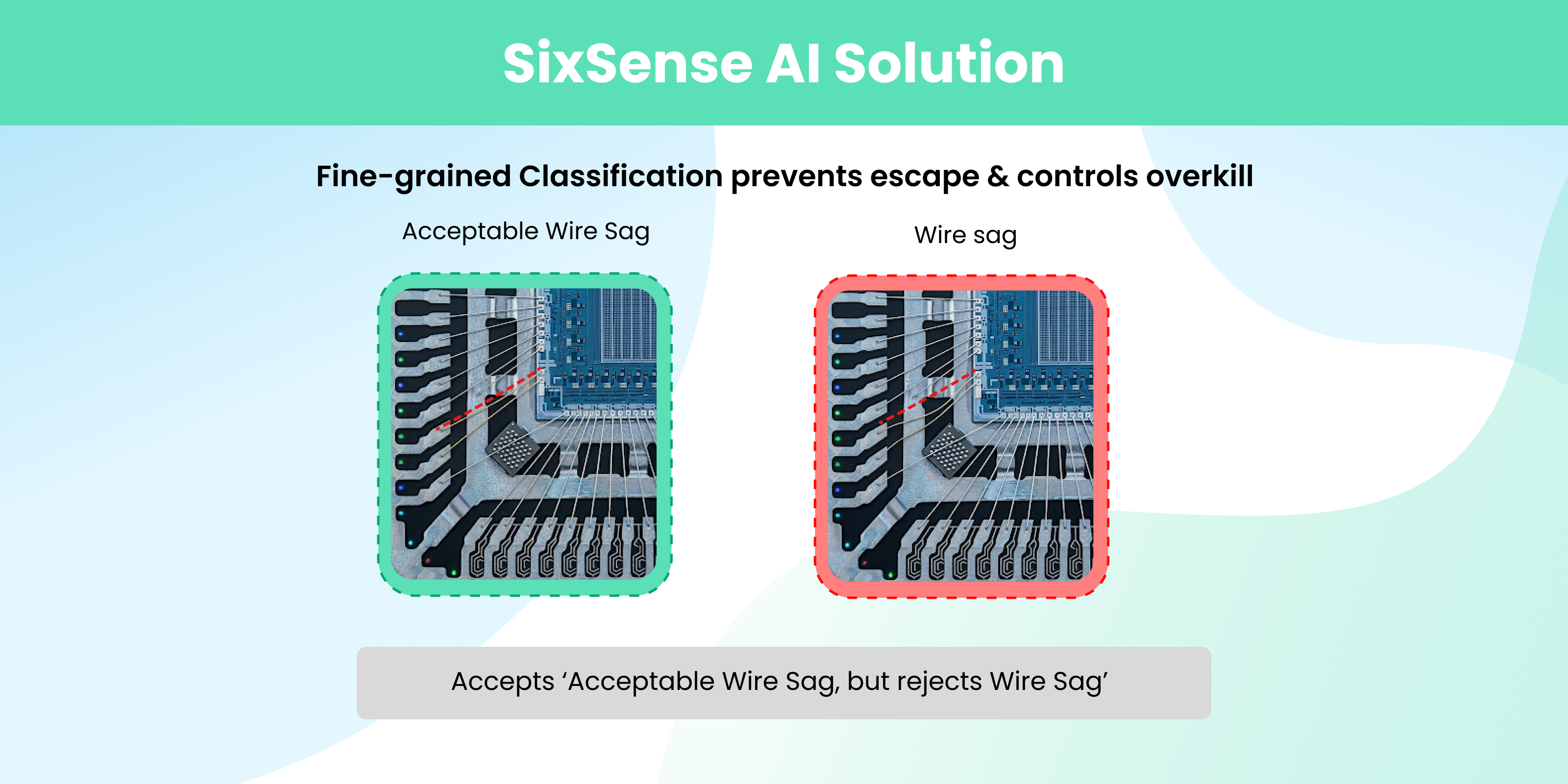
Sixsense partnered with a vision OEM to deploy AI-ADC as the first check in the inspection pipeline. The OEM's equipment captures images of every wire bond on the line, and Sixsense AI-ADC analyzes 100% of these images in real time. Each image is classified as good or defective, and defective units are further categorized into defect types such as Wire Sagging, Excess Wire, Foreign Material, Wire Short and others. Because AI operates as the primary inspection step rather than a secondary review, throughput was a critical design requirement, and the system was engineered to process images at production speeds without introducing bottlenecks.
Overcoming Limited Data with a Pretrained Foundation Model
The key to achieving high accuracy despite the uneven dataset was the Sixsense pretrained foundation model. Unlike models trained from scratch, the Sixsense foundation model has been pretrained on millions of defect images including clean labeled data, noisy or unlabeled images, and synthetic samples. This broad pretraining gives the model a strong prior understanding of defect patterns, enabling it to generalize effectively even when only a handful of examples are available for a specific defect class. For the customer, this meant that defect categories with fewer than 20 training images still reached the accuracy levels required for live production.
Fast, Self-Service Model Launch
A core requirement from the customer was a simple interface that would let their own team launch models with minimal effort. Sixsense's UI platform delivered exactly that: the entire workflow, from data selection and preparation to model training and validation, is accessible to non-AI experts.
The result was a launch timeline of under two days from model creation to production deployment. The engineering team was particularly impressed that performance metrics were easy to view and share with management, removing the need for intermediate analysis by AI specialists.
Deployment Details
Results
The model ran live inference on the production line for two to three weeks on >100k units for nearly 30 lots. Performance exceeded the customer's production-grade requirements across every key metric.
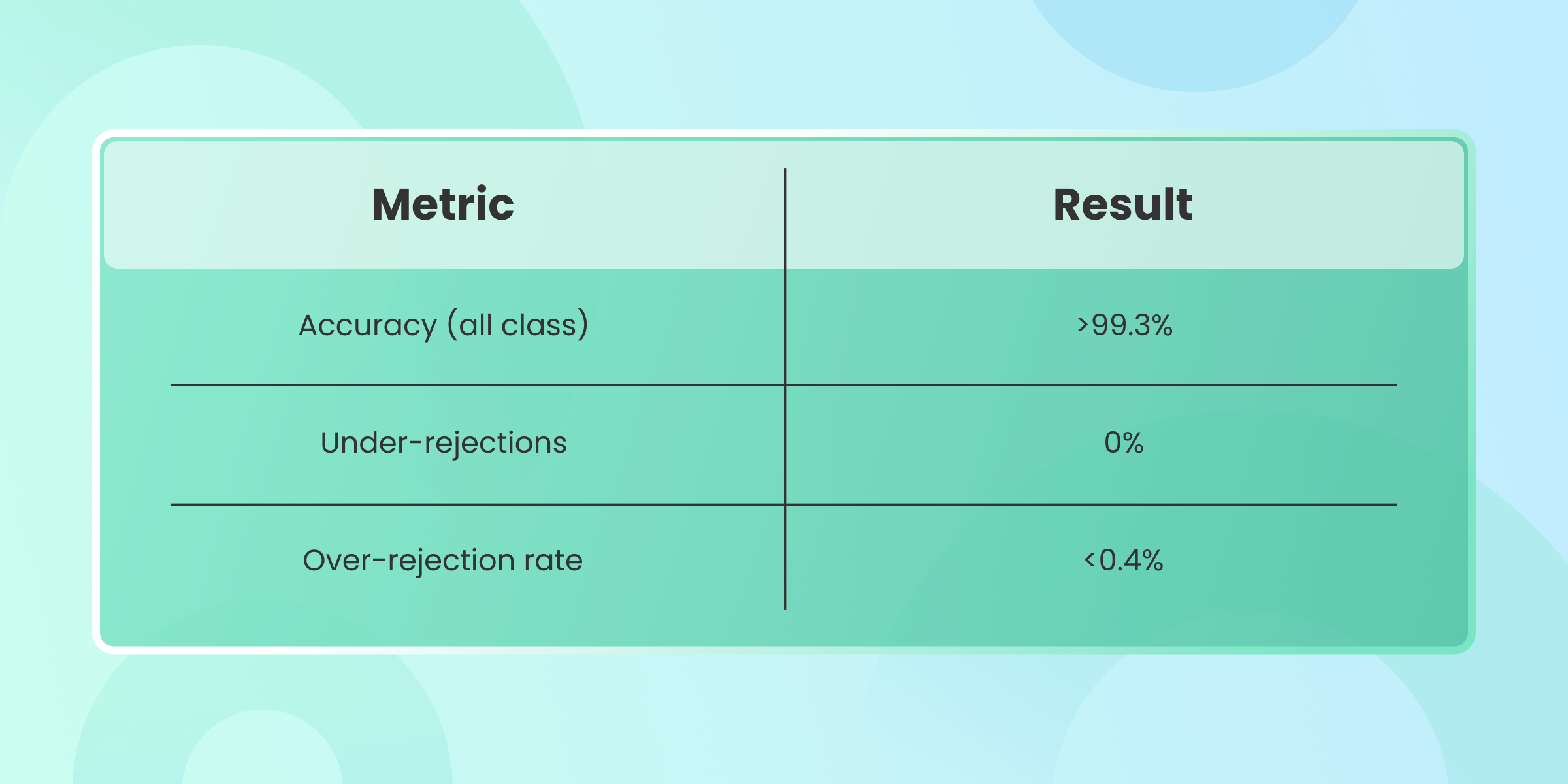
AI-ADC recovered a substantial volume of previously over-rejected units while maintaining zero escapes.
Explainability Through Heatmaps
Every inference is accompanied by a heatmap that highlights the image regions driving the classification, giving engineers clear visibility into why the model made each call. This explainability was an important factor in building trust with the floor team and in validating model behavior on ambiguous cases.
Addressing the Hardest Cases: Borderline Defects
One of the persistent challenges at post wire bond inspection is the borderline Accept/Reject criteria that applies to certain defect types. These are cases where even trained human inspectors may disagree, and where rule-based systems lack the nuance to make a confident call. AI-ADC handled these scenarios reliably, classifying ambiguous cases consistently across the production line and reducing the variability that typically comes with manual review.
Summary of Key Outcomes
- 0% escapes and <0.4% over-rejection, resolving the trade-off between defect containment and yield
- AI Throughput scalable to >20k units/hour, with AI operating as the first check
- High accuracy despite limited data, enabled by the Sixsense pretrained foundation model
- Under two days from model creation to production deployment through a self-service UI
- Heatmap-based explainability available with every inference
- Reliable handling of borderline defects that rule-based systems and earlier AI attempts could not classify consistently
- Fully operable by using a simple UI by defect engineers, without dependency on external AI expertise