

How SixSense helped a high-volume CIS and ceramic substrate manufacturer build a scalable AI inspection workflow for tiny, critical defects with 0 under-rejections.
The Problem Was Not Just Volume. It Was the Cost of Missing One Tiny Defect.
A global manufacturer of specialized micro-module packaging and ceramic metallization substrates operates a high-volume back-end manufacturing environment serving demanding imaging and packaging applications.
Within its wafer reconstruction process, individual dies are inspected and only good dies are selected for assembly into a new wafer. Inspection quality is therefore directly connected to downstream product quality.
The scale of the operation was significant:
- 110 million inspection images per year
- Full-scan inspection across one inspection layer
- Two devices and 10+ defect classes
- Multiple inspection platforms
At this scale, manual classification was becoming increasingly difficult to sustain. More images meant more review workload, but additional operator headcount was not available to grow at the same rate.
The customer needed to solve two problems simultaneously:
1. How can inspection capacity scale without proportional operator growth?
2. How can AI automate classification without compromising the strict requirement to control under-rejection?
The AI Evaluation Had Already Been Tried
The customer had spent several years evaluating another AI solution. However, image-level under-rejection remained above 3% during evaluation, while over-rejection was not also within the target set by the customer.
For a CMOS image sensor-related inspection application, this was a critical limitation.
The inspection challenge was particularly demanding because defects could occupy only a very small region of the image with defect categories included debris, Black Foreign Material, IQC-related defects and other classes across more than 10 classifications.
The model could correctly interpret the overall image yet still miss subtle defects that determined whether a die should be accepted or rejected. This limitation was a key reason the previous AI vendor struggled to deliver the level of inspection performance required by the customer.
The customer therefore needed more than a high classification accuracy score. They required an AI solution capable of detecting even the most subtle defects with zero escapes, while minimizing the unnecessary rejection of good dies which is a challenging balance to achieve in high volume production.
The Breakthrough: Better Data Before More Training
How Does Sixsense Do It Differently?
The customer had approximately six months of historical inspection data, containing millions of operator-labelled images.
The challenge was not a lack of data. It was making the data useful.
Historical labels could vary across operators, lots, wafers and production periods. Simply training on millions of images risked reproducing inconsistencies or over-representing repetitive examples.
SixSense took a different approach.
Find the right images first.
The workflow began with initial historical data grouping, followed by the use of Unique Images to identify visual variations across production data.
This helped the team discover representative examples from:
- Different lots and wafers
- Different production periods
- Different defect appearances
- Different visual conditions
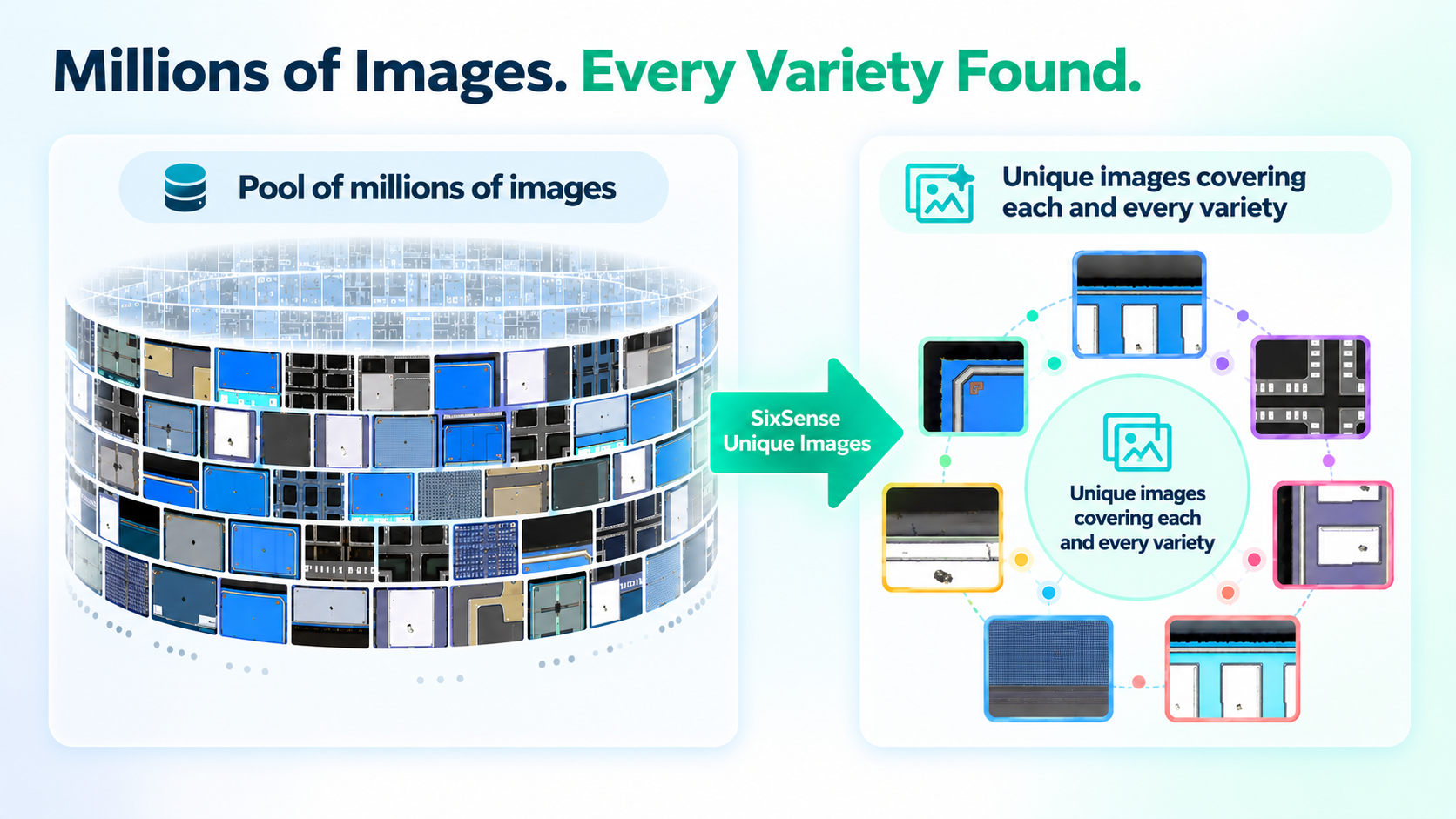
The objective was to build a more effective training dataset without relying on an enormous volume of manually prepared images.
With SixSense’s proprietary image management software, the model training process is streamlined through intelligent image selection by selecting the most informative images and removing noisy and inconsistent data. that identifies representative samples covering the full range of defect variations. This curated approach helps the model learn more accurately and achieve broader, more representative coverage across different tools, devices, and manufacturing processes.
By curating the most relevant and diverse training data, SixSense reduces the effort required for data preparation while optimizing model performance in classification accuracy, under-rejection (UR), and over-rejection (OR). This is one of the key areas where SixSense differentiates itself from other suppliers by significantly reducing the time and effort required to develop and train high-performance AI models.
Detecting Subtle Defects That Traditional AI Models Struggle to Distinguish
Reduction in model training time and release of the production is not just enough.
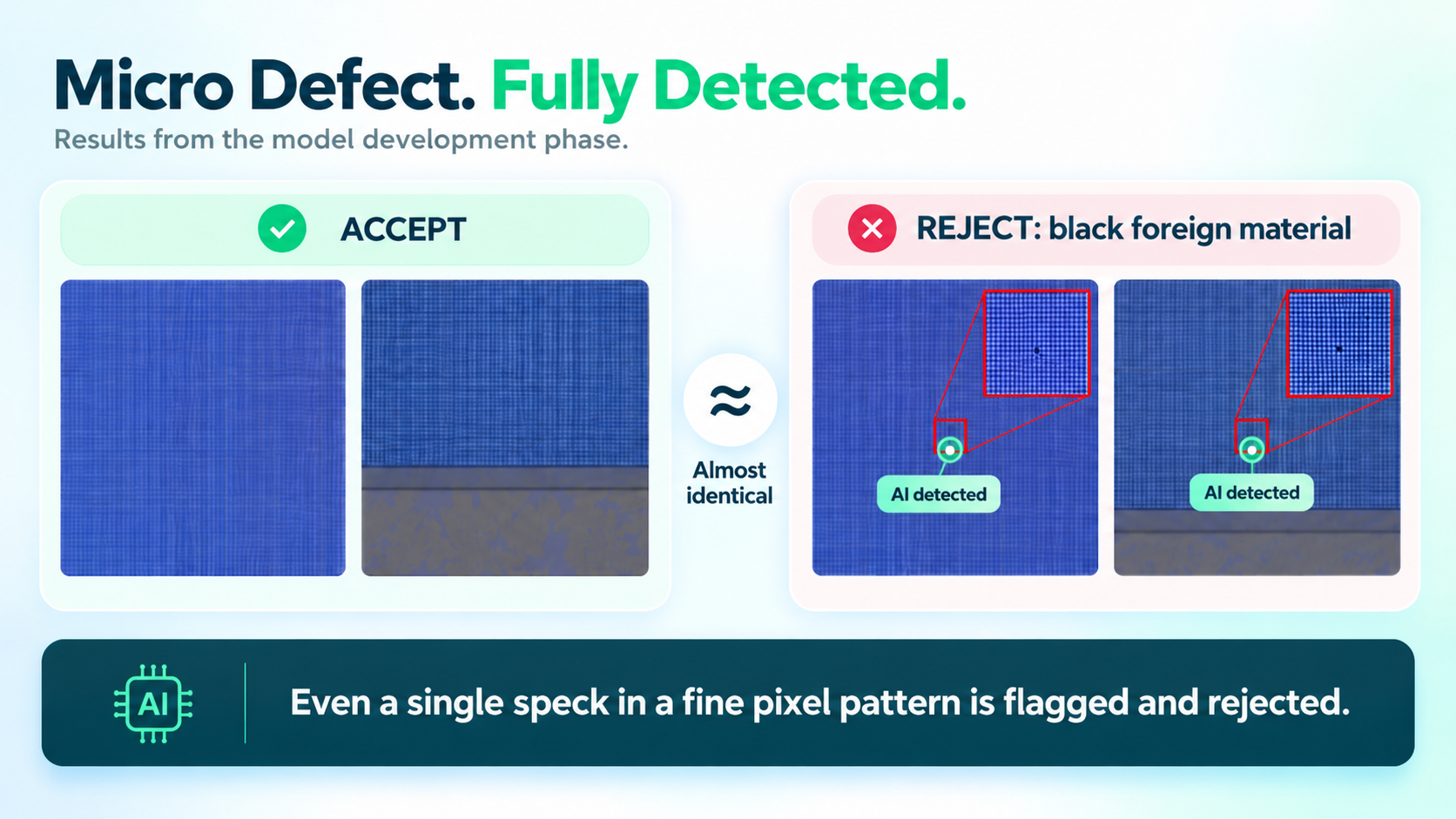
In semiconductor inspection, some defects can look remarkably similar to acceptable patterns. The difference between a good die and a defective one may be extremely subtle, sometimes involving only a small deviation in shape, continuity, or pattern within a critical region.
These subtle differences can have a significant impact on classification accuracy. If the model fails to recognize a genuine defect and accepts it as good, it results in under-rejection (UR). Conversely, if the model incorrectly identifies an acceptable pattern as defective, it leads to over-rejection (OR). Striking the right balance requires the model to distinguish between defects and acceptable variations with a high degree of precision.
This was a key challenge observed during previous AI evaluations, where the models struggled with under-rejection. Defects that closely resembled acceptable patterns were not always identified correctly, creating a risk that defective dies could pass through the inspection process undetected.
This is where SixSense differentiates itself. Models are trained to recognize subtle defect characteristics and distinguish them from acceptable pattern variations, rather than relying solely on broad visual similarities. By learning the fine details that separate a genuine defect from an acceptable structure, SixSense delivers more reliable classification, even when the differences are difficult to identify through conventional inspection approaches.
Validating Performance Under Real Production Conditions
To validate the model's performance beyond familiar training data, the customer evaluated SixSense’s model using 25+ completely unseen production lots. These lots provided a meaningful test of the model's ability to generalize across real manufacturing variations, rather than simply reproducing results from previously observed samples.
The evaluation was conducted in shadow mode, where SixSense classified inspection images in parallel with the existing production inspection process. The AI results could therefore be assessed against the established inspection decisions without immediately taking control of production, allowing performance to be evaluated under realistic manufacturing conditions while minimizing disruption to ongoing operations.
Superior Classification Quality With Zero Under-Rejection
The evaluation demonstrated a significant improvement in classification quality compared with the previous AI evaluation.
- 0% Under-Rejection (UR): No under-rejected defects were observed in the evaluated dataset, demonstrating SixSense's ability to distinguish subtle defects from acceptable patterns within the test scope.
- Less than 0.66% Over-Rejection (OR): Fewer than 0.66% of acceptable dies were incorrectly rejected, helping preserve good-die yield while maintaining defect detection performance.
This represented a significant improvement over the previous AI supplier’s performance and, more importantly, met the customer’s stringent inspection requirements.
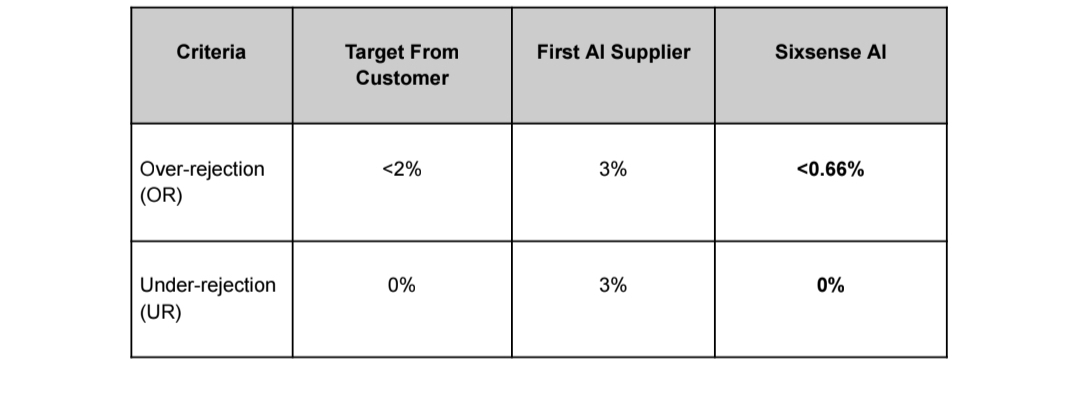
The result demonstrates SixSense's ability to distinguish subtle defect variations with greater precision, delivering a stronger balance between defect detection and yield preservation under real production conditions.
Impact for Customer
At an inspection volume of 110 million images, manual review would have created substantial operational overhead, with costs increasing further as production volumes grew. Adopting AI was a clear priority for the customer, but the performance requirements were demanding: achieve 0% under-rejection (UR) while minimizing over-rejection (OR). The previous AI solution from another vendor struggled to meet these expectations.
With SixSense, the customer was able to achieve the required performance, recover at least 2% improvement over-rejection compared with the previous AI supplier, reduce unnecessary rejection of good dies, and improve yield and cost efficiency. At the same time, achieving the targeted 0% under-rejection significantly reduces the risk of defective dies escaping inspection and causing downstream quality issues, which could potentially result in millions of dollars in financial losses.